


Chain Sling
Henan Best Chain Co., Ltd
Henan Best Chain Industry Co., Ltd. is a national standard [high-precision hoist chain (G80 grade, G100 grade), ordinary rigging chain (G80 grade, G100 grade), etc.], EU standard (EN/80 grade, 100 grade) Chain products, professional R & D, design, manufacturing enterprises.
Why Choose Us
Experienced Team
Our team of engineers and technicians has years of experience in the industry, and we leverage that expertise to provide our clients with the best possible solutions.
Exceptional Customer Service
We pride ourselves on providing exceptional customer service and technical support to our clients, ensuring that they have a smooth and hassle-free experience.
Quality Products
We use only the highest-grade materials and advanced manufacturing techniques to produce products that are reliable, durable, and perform to the highest standards.
Competitive Price
We have professional sourcing team and cost accounting team, stive to reduce cost and profit and provide you a good price.
Sustainable Development
Establish a good reputation and brand value in the industry, and promote the sustainable, stable, rapid and healthy development of the enterprise.
One Stop Solution
From the begining inquiry and throughout the entire process until you receive the goods. we are dedicated to supporting you every step of the way.


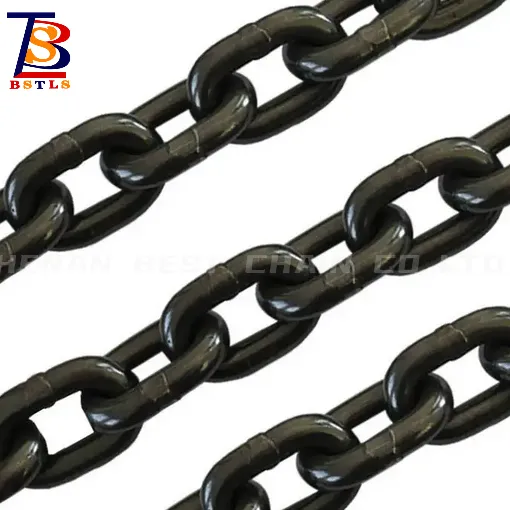
Chain slings are lifting devices made of high-strength alloy steel chains. They consist of a chain with hooks, links, and other end fittings that facilitate attachment to the load and lifting equipment. chain slings are known for their durability, resistance to abrasion, and high load-bearing capacity. They are suitable for various lifting applications, including construction, manufacturing, shipping, and heavy machinery industries.
Advantages of Chain Sling
Strength and Durability
Chain slings are designed to withstand heavy loads and harsh working conditions. They are highly resistant to abrasion, impact, and extreme temperatures, ensuring long-lasting performance.
Versatility
Chain slings come in various configurations, such as single-leg, double-leg, and multi-leg slings, allowing flexibility to lift loads of different shapes, sizes, and weights. They can also be adjusted easily to accommodate specific lifting requirements.
Load Control
Chain slings provide excellent load control due to their rigidity and ability to maintain shape during lifting. This ensures greater stability and minimizes the risk of load shifting or accidents.
Extended Reach
With the use of chain slings, workers can achieve extended reach and maneuverability, allowing them to access hard-to-reach areas and lift loads from different angles.
Chain lifting slings, which are renowned for being tough and resilient, are used to move awkwardly shaped, difficult-to-position objects, or heated materials. The chains come in several grades, with the greater the grade rating, the stronger the chain.
During high-temperature situations and when lifting significant weights, chain slings are favored. They can be utilized in manufacturing facilities, steel plants, heavy engineering firms, and every other setting where repeated elevations or extreme conditions could harm or ruin a wire rope sling, synthetic nylon, or polyester sling because of their durability and longevity. An entire repair can be made to a chain sling should any damage occur.
When it comes to difficult lifting scenarios, steel chain slings and assemblies are the best choice because of their overhead lifting construction, durability, and superior performance. Chain slings are strong, temperature-resistant and designed to handle a variety of work environments. There are many types of chain slings, including single-leg, two-leg, three-leg, and four-leg.
Types of Chain Sling
Be heavily dependent on what and how you are lifting the load. The most commonly used chain assemblies are illustrated below, also illustrated are special assemblies that may be devised for lifting specific or unusually shaped loads.
Single Leg Chain Sling
A single leg chain sling consists of a single chain with end fittings. It is suitable for straightforward lifting operations where a single point of attachment is sufficient. This type of adjustable chain lifting slings is commonly used for lifting smaller loads or in applications where flexibility and maneuverability are required.
Two Leg Chain Sling
A Two leg chain sling is made of two chains with end fittings, serving a crucial role in lifting operations. Its design offers enhanced stability and balance, especially when handling longer or wider loads. By attaching the two legs of the sling to separate lifting points, this type of chain sling enables improved load distribution and control. It is commonly employed when lifting larger and heavier objects, or whenever additional support is required to ensure safe and efficient lifting.
Three Leg Chain Sling
A Three leg chain sling consists of three chains with end fittings. It is designed to lift irregularly shaped or extremely heavy loads that require extra support and balance. The three legs of the sling distribute the load evenly, reducing stress on individual chains and ensuring safer lifting operations. This type of chain sling is commonly used in industries such as construction, manufacturing, and transportation.
Four Leg Chain Sling
A Four leg chain sling consists of four chains with end fittings. It offers even greater stability and load distribution compared to the triple-leg sling. This configuration is typically used for lifting extremely heavy or bulky loads that require maximum support and control. The four legs of the sling provide enhanced stability and prevent load shifting during lifting.
There is a wide range of fittings and customisation available for chain slings depending on the application. As such, we manufacture chain slings in-house to meet Australian standards.
Different Chain Sling Applications
Before we start making your chain sling, we need to work out the correct configuration and requirements for the operation it will be used for. Applications can include lifting personal and material cages, spreader bars or attached directly to the materials being lifted. We need to know the working load limit, chain sling leg length, how many legs and any other specific requirements.
Chain Sling Configurations
Once we know all of the specifications for the lift, we can determine the configuration to make the right chain sling for your application. We customise the components of a chain sling including:
●Length of the chain legs (based on the height of lift)
●Chain size
●Type of chain
●Number of chain legs
●Hooks and bottom fittings
Examples of common configurations for chain slings. The chain sling consists of a head ring, a coupler, a short eye hook, a label (for authentication and identification) chain and a U-shaped safety sling hook from top to bottom.
Assembling The Chain Sling
We collect all of the rated lifting components required and cut the chain to the correct length. All of the parts are then joined together with either couplers or clevis (pin) fittings. The fittings are checked before fitting to ensure they are correct. The bottom of the chain slings are commonly fitted with hooks with a safety latch locking mechanism.
Compliance Certification
Once the chain sling is built, a proof load test is performed. The chain is mounted on our hydraulic test bench and the load is gradually applied until the required proof load is reached.
The chain and components are thoroughly checked for any changes compared to before the testing. If all components pass, the complete chain sling will be issued with a test certificate.

If your job requires a sling that will handle rough, heavy duty lifting as is common in steel fabrication or ship building, Chain Slings may be your best solution. The general characteristics of Chain Slings allow them to stand up to everyday use. Many Sling variations are available to allow on site adjustments to fit your every requirement.
Versatility and Durability are reasons that chain slings are considered a great option. Because these slings have incredible features, they can be used in a variety of ways. You should have no trouble finding a configuration to meet your lifting requirement.
Their robust construction ensures effective performance in rigorous settings, making them a reliable tool in heavy industry and construction sectors. Chain slings excel in environments where strength and longevity are paramount, providing confidence in challenging lifting operations.
How To Use The Chain Sling Correctly
The operator should wear protective gloves before operation.
Confirm that the dead weight of the hoisted object matches the load of the chain hoisting rigging. Overload work is strictly prohibited!
Carefully check whether the chain is twisted, knotted, knotted, etc. If the following conditions occur, please adjust the chain first before proceeding to the next step.
Find the appropriate center of gravity when the chain hoisting rigging is attached to the heavy object to be hoisted, and ensure that there is no problem with the center of gravity before lifting.
Before hoisting heavy objects, check whether there is good protection between the chain hoisting rigging and the heavy objects, so as not to damage the surface of the heavy objects during hoisting.
Check whether there are personnel working and obstacles within the lifting range. The site should be cleared in time, and the obstacles can be removed before lifting.
After the heavy object is hoisted, no one should pass under the heavy object, or check the construction at the bottom.
Chain hoisting rigging is strictly prohibited to be used in hot-dip galvanizing tank and pickling tank.
How To Choose Chain Sling
Determine the lifting capacity needed
What is the weight of the load to be lifted, Identify the center of gravity of the load to be lifted.What is the lifting capacity of the equipment available (crane)?
Define the number of strands needed
How many anchor points are there on the load? 1, 2, 3 or 4?
Reminder: when slinging on 4 legs, a maximum of 3 legs are considered to be bearing, the fourth leg only intervening for balancing.
Choose The Chain Grade
50, 80, 100 or 120.
For the same chain diameter, increasing the chain rating of a sling can benefit from a higher lifting capacity. Your sling will weigh less.
Calculate The Length Of The Sling
This step is crucial because the length determines the working angle of a multi-leg sling.The greater the angle, the greater the stress on the sling ring, and the greater the angular load loss on each leg.
The length of the strands should be determined in such a way as to keep an optimal angle of the strand with respect to the vertical axis between 0 and 45.
Define The Sling Termination
Hook with automatic locking, swivel, latch. You must ensure compatibility between the accessories of your sling and the external elements that will be connected to it (hoisting device hooks, anchorage on the load, etc.).
Determine The Options
The use of shortening clutches: to adapt the length of the sling legs to suit to make it more versatile and adapted to the part to be lifted.
The possibility of optionally affixing your own traceability to the sling.
Application Notes of Chain Sling
Chain sling is formed by connected by metal rings. According to its form, it is divided into two types: welded type and assembled type. According to its structure, there are single legs, multiple legs, etc. It is made of high-quality alloy steel and is wear-resistant and high-temperature resistant. Suitable for large-scale and frequent use. Flexible multiple legs and various combinations improve work efficiency and reduce costs.
●Before lifting operation, make a precise plan how to hang, hoist and unload .
●Prepare: Determine the weight and gravity center of the object to be lifted, carefully read the instructions, and mark the lifting point and weight data. The position of the hook can be only determined after you find the center of gravity!
●The operator must be informed of the weight being lifted.
●The crane hook should be hung vertically above the center of gravity of the object to be lifted.
●During the lifting operation, not only damage the lifting object should be avoid, but also prevent damage to the rigging itself. To avoid rotation and falling, the following conditions should be observed:
a) Single legged sling, the lifting point should be vertically above the center of gravity of the lifting object.
b) If it is a two-legged sling, the hanging point should be on the both side of the lifting object and the lifting point above the center of gravity.
c) If it is a three-legged and four-legged sling, the hanging point should be evenly placed at the level of the center of gravity of the lifting object and above the center of gravity of the object to be lifted.
Attention must be paid to the lifting angle β (between the vertical line and the hanging leg): the larger the lifting angle, the smaller the lifting capacity. A lifting angle of more than 60 degrees is absolutely not forbid!
If a three- or four-leg chain sling is used to lift a non-uniformly distributed lifting object, then the rated load of each leg should be correctly calculated. When the leg has different inclination angles, the lifting load of each leg should be calculated by lifting only the entire lifting object with one chain.
Safe Use & Maintenance of Chain Sling


Safe Use
Never load chain slings in excess of the rated capacity for the application.
●Keep a register of all slings in use.
●User should remove all twists from a chain leg before lifting and must never knot a chain.
●Always use a shortening hook or clutch when chain legs require shortening.
●Always inspect slings to ensure that chain is free from damage or wear before each use.
●Always inspect all sling components prior each use.
●Ensure that chain is protected from any sharp corners on the load.
●Ensure that the master link articulates freely on the crane hook or other lifting appliance.
●Never point load hooks. The load should always seat correctly in the bowl of the hook.
●Always use the correct size sling for the load, allowing for the included angle and the possibility of unequal loading.
●Persons must stand clear of all loads while lifting.
Maintenance
A thorough examination must be carried out by a competent person at least every 12 months or more frequently according to statutory regulations, type and frequency of use.
Chains with bent links or with cracks or gouges in the link should be replaced, as should deformed components such as bent master links, deformed hooks and any fittings showing signs of damage.
Chain and components wear should never exceed 10% of the original dimensions.Once a chain sling has been overloaded it must be taken out of service.
Store chain sling on a properly designed rack. Never leave chai n slings on the floor where they may suffer mechanical or corrosion damage.
Alloy chain slings should not be used in acid or caustic solutions nor in heavily acidic or caustic
laden atmospheres. The heat treated alloy material used for alloy steel chains and components is susceptible to hydrogen embrittlement when exposed to acids.
Chain slings must not be heat-treated, galvanised, plated, coated or subject to any process involving heating or pickling. These processes can have dangerous effects and will invalidate the manufacturer's certification.
Alloy chain slings may be used at temperatures between -40°C to 200°C with no reduction in the Working Load Limit. The use of chain slings within the permissible temperature range in the table does not require any permanent reduction in Working Load Limit when the chain sling is returned to normal temperatures.
A sling accidentally exposed to temperature in excess of the maximum permissible should be withdrawn from service immediately and returned to Cookes for thorough examination.
When using alloy chain slings in exceptionally hazardous conditions, the degree of hazard should be assessed by a competent person and the Working Load Limit adjusted accordingly.
Certifications


Our Factory
Henan Best Chain Industry Co., Ltd. is a national standard [high-precision hoist chain (G80 grade, G100 grade), ordinary rigging chain (G80 grade, G100 grade), etc.], EU standard (EN/80 grade, 100 grade) Chain products, professional R & D, design, manufacturing enterprises. It is a "management advantage and technical advantage" enterprise of high-grade, high-end, multi-variety and multi-spec chain in the north.

